A new way of reading infrastructure
The safety of bridges and viaducts does not depend solely on the quality of their design or the frequency of inspections. Increasingly, it depends on the asset manager’s ability to understand how the structure behaves every day under actual traffic loads, environmental conditions, and material ageing. From this perspective, structural monitoring is no longer a specialist activity limited to occasional assessment campaigns. It becomes a permanent component of infrastructure asset management.
The key point is straightforward: a bridge is not subjected to theoretical loads, but to real vehicles. Heavy goods vehicles, abnormal-load transports, repetitive traffic, unevenly distributed loads, and changing operating conditions generate structural actions that vary over time. For this reason, knowing only the structural response is not enough. Likewise, traffic data alone cannot explain the effects produced on the structure. The real value emerges when these two sets of information are analysed together.
This requirement led to the development of GRIFFON, iWIM’s fiber-optic structural monitoring system, integrated with BISON, the company’s weigh-in-motion system.
The solution associates each vehicle passage with data on gross vehicle weight, axle configuration, speed, and vehicle class, and correlates these parameters with the bridge deck response measured by the structural sensors. In other words, the system makes the cause-and-effect relationship between traffic loads and infrastructure response directly observable.
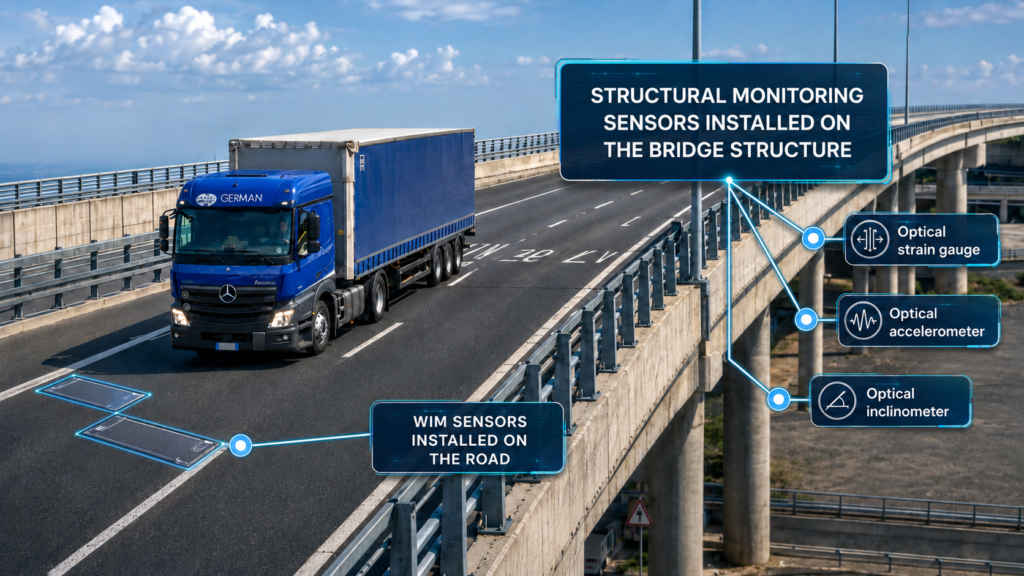
Operating principle of the integrated system: weigh-in-motion data collected from vehicles in motion are analysed together with the structural parameters measured by the fiber-optic sensor network.
From monitoring to management value
The operational objective of the solution is to provide infrastructure managers with a clearer and more reliable basis for decision-making.
The availability of continuous, synchronised data makes it possible to move from reactive maintenance—where action is taken only after a problem occurs—to predictive and risk-based maintenance supported by measured evidence.
For concessionaires, public authorities, engineering firms, and road network operators, this means being able to distinguish ordinary operating conditions from genuinely critical events, plan targeted inspections, assess the effects of heavy traffic, and document changes in structural behaviour over time.
Structural monitoring therefore becomes both a risk-management tool and a means of supporting long-term financial and maintenance planning.
Technical data are transformed into actionable information:
- Which vehicle passages generate the highest structural demand?
- Which parameters are changing compared with the structure’s historical behaviour?
- Which thresholds require attention?
- Which interventions should be brought forward?
- Which activities can be scheduled more efficiently?
In this way, technology does not remain an isolated component. It becomes fully integrated into the infrastructure manager’s decision-making processes.
Integrated data between vehicle weight and structure response.
GRIFFON combines a network of optical sensors installed on the structure with a dedicated software platform for data acquisition, visualisation, and analysis. The system can measure strain, inclination, vibration, displacement, temperature, and other parameters relevant to the structure’s behaviour. Its defining feature is its native integration with BISON, which continuously detects passing vehicles and determines their main dynamic characteristics.
The time synchronisation between the two systems allows the operator to select an individual vehicle and analyse the corresponding structural response. For example, the infrastructure manager can assess how an abnormal-load vehicle or an overloaded vehicle affected the bridge deck at a specific moment in time. This correlation is particularly valuable for:
- infrastructure carrying high volumes of heavy traffic;
- existing bridges with incomplete historical documentation;
- strategic assets where service continuity is essential.
The combination of weigh-in-motion and structural monitoring also enriches numerical models and digital twins with actual in-service data. The objective is not merely to simulate a scenario, but to compare the model with what occurs on the structure every day.

Integrated web interface of the Grifone and Bisonte systems: the operator can select a single transit and view the response of the deck associated with the vehicle, with synchronized graphs and parameters.

From transit to operational decision.
Fiber optics as a strategic choice for more stable and reliable monitoring
Fiber-optic technology is one of the key strengths of the solution.
Optical sensors are passive, require no electrical power supply in the field, and are immune to electromagnetic interference. These characteristics reduce many of the issues associated with conventional monitoring systems based on electronic components installed directly on the infrastructure.
For infrastructure managers, the choice of technology has a direct impact on the total cost of ownership. A system installed on a bridge or viaduct must remain stable, durable, and reliable under demanding environmental conditions, including humidity, temperature fluctuations, vibration, de-icing salts, rain, frost, and continuous traffic. Fiber-optic technology makes it possible to design a robust and scalable measurement network with reduced maintenance requirements and the ability to expand the system over time.
This is particularly important when monitoring is not intended as a temporary test campaign, but as permanent digital infrastructure. GRIFFON can be configured according to the structure’s specific vulnerabilities, design requirements, and the infrastructure manager’s objectives, while maintaining a modular approach—from the monitoring of a single bridge to the management of multiple structures across an entire network.

Optical sensor installed on a deck beam: passive fiber optic sensors enable stable and durable measurements in complex infrastructure environments, without active electronics in the field.
An intuitive platform for clear and continuous monitoring
The software platform is where raw data are transformed into understandable information. Through a web-based interface, operators can view vehicle passages, examine structural parameters, compare historical trends, configure alarm thresholds, and generate reports. The objective is not simply to display graphs, but to support the operational interpretation of events.
The ability to associate each vehicle passage with the corresponding bridge deck response enables intuitive navigation from the vehicle to the bridge and from the bridge back to the vehicle. This approach simplifies anomaly analysis and makes it possible to reconstruct significant events more clearly.
In the event of overloaded vehicles, abnormal-load transports, or unexpected variations in structural parameters, the system provides practical support for deciding whether to:
- initiate a technical assessment;
- schedule an inspection;
- revise maintenance priorities.
The reporting tools also transform continuous monitoring into structured technical and management documentation. For public authorities and companies required to demonstrate effective infrastructure control, the availability of historical time series, performance indicators, and periodic reports improves the traceability of decisions.

Communication and data management architecture: Optical sensors, dataloggers, software platform and dynamic weighing systems work in a synchronized way to generate operational information.

Structural monitoring dashboard: the visualization of the trends of strain gauges, inclinometers, deck height and temperature helps the operator to read the evolution of the behavior of the structure.
The case of Brescia's South Ring Road
The first case study, carried out in collaboration with DICATAM at the University of Brescia, concerns a bridge on the Brescia South Ring Road along the SPBS11 route. The structure is located on a major road corridor characterised by high traffic volumes and a significant proportion of heavy vehicles, making it an ideal site for assessing the performance of an integrated structural monitoring and weigh-in-motion system.
The bridge was instrumented with optical sensors installed at structurally significant locations on the deck. Two weigh-in-motion systems were also installed in the slow lanes, one in the direction of Milan and the other in the direction of Verona. This configuration allows vehicle passages and the bridge’s structural response to be recorded simultaneously.
The data collected during the case study made it possible to analyse the structure’s behaviour under actual traffic conditions and compare the results with the numerical model. The example of an abnormal-load transport demonstrated how the system can associate the vehicle load with the strain measured on the bridge deck, providing a direct and readily understandable assessment of the resulting structural effect. For the infrastructure manager, this type of information is particularly valuable. It does not describe an abstract scenario; it documents what the infrastructure actually experienced.

Pilot case on the Brescia South Ring Road: the configuration makes it possible to monitor heavy traffic and the structural response of the work in a high-intensity transit context.

Diagram of the positioning of the sensors on the bridge of the case study: the measurement network is designed according to the characteristics of the work and the most structurally significant points.
Benefits for managing bodies and concessionaires
The adoption of an integrated system such as GRIFFON delivers benefits at several levels. The first is safety. Continuous monitoring makes it possible to identify abnormal events and structural stress conditions promptly. The second is efficiency. Maintenance resources can be directed towards the areas where measured data demonstrate a genuine need, reducing low-priority activities and avoiding maintenance programmes based on generic assumptions.
The third benefit concerns service continuity. Strategic infrastructure such as bridges, viaducts, port access routes, logistics corridors, and high-traffic roads cannot be managed solely through closures and occasional inspections. Continuous monitoring increases knowledge of the structure without interrupting traffic and provides ongoing support for operational decision-making.
A further benefit relates to governance. The correlation between each vehicle and the corresponding structural response increases transparency in risk management and makes it possible to build a digital history of the infrastructure. Every significant event can be stored, compared, and used to develop more informed maintenance strategies.

Benefits for the infrastructure manager. The image highlights security, cost, continuity, traceability and scalability as concrete results of the integrated solution.
From Pilot Testing to Network-Wide Deployment
The value of GRIFFON is not limited to a single case study. The solution is designed for deployment on existing bridges and viaducts, new structures, infrastructure exposed to heavy traffic, and locations where overload control and predictive maintenance are priorities. Its modular design allows the configuration to be adapted to the characteristics of each structure and to the objectives of the monitoring project.
At a time when infrastructure digitalisation is increasingly driven by regulations, investment programmes, and sustainability strategies, the integration of structural and traffic data represents a natural step forward. Infrastructure managers do not simply need to know that a bridge is being monitored. They need to understand what is happening, why it is happening, and which decisions should result from that knowledge.
GRIFFON addresses this requirement through an industrial, scalable solution designed for long-term operation. Monitoring is not presented as an additional cost, but as a tool for reducing risk, optimising maintenance activities, and protecting the value of the infrastructure.
Conclusions
The modern management of bridges and viaducts requires tools that combine technology, reliability, and operational value. With GRIFFON, iWIM proposes an approach in which fiber-optic structural monitoring and weigh-in-motion do not operate as separate systems, but as components of a single integrated information ecosystem.
The ability to associate each vehicle with the structure’s actual response creates new opportunities for predictive maintenance, risk assessment, and investment planning. For infrastructure managers and concessionaires, this means having access to a system that does not merely measure—it supports informed decision-making.
In this vision, the bridge is no longer a silent infrastructure asset observed only through periodic inspections. It becomes a digital asset capable of telling its own story in real time, enabling those responsible for its management to act earlier, more effectively, and with greater awareness.

Griffon + Bison integrated architecture: the system combines dynamic vehicle weighing, structural fiber optic sensors and a software platform to correlate each transit to the real response of the deck, transforming continuous monitoring into operational information for safety, predictive maintenance and infrastructure management.

Intelligent structural monitoring: an integrated view between traffic loads and infrastructure response

Intelligent structural monitoring: an integrated view between traffic loads and infrastructure response
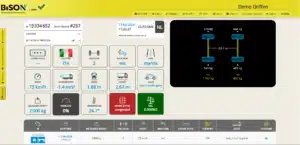
Integrated software for monitoring traffic and health of infrastructures with BISON and GRIFFON

Dynamic Weighing Basics: The Fundamentals of Weigh-in-Motion

The Dynamic Weighing System for Construction Sites – Low Speed WIM