INTEGRATED STRUCTURAL MONITORING AND DYNAMIC WEIGHING
Developed by iWIM in collaboration with the University of Brescia, GRIFFON introduces a new integrated approach to infrastructure monitoring through the use of innovative fiber optic technology andintegration with dynamic weighing.
ABSTRACT
GRIFFON is the new integrated system developed by iWIM for infrastructure monitoring: it combines dynamic vehicle weighing and continuous structural monitoring through fiber-optic sensing in a single platform. The system provides real-time data on the structural response of works and vehicular loads, enabling predictive maintenance based on objective indicators. Key features include minimally invasive intervention, historical analysis capability, automatic alarm generation, and interoperability with BIM and Digital Twin environments.
The case study carried out on a bridge on the Brescia South Bypass, carried out in cooperation with DICATAM (Department of Civil Engineering, Architecture, Land, Environment and Mathematics) of the University of Brescia, is presented.
THE safety and efficiency of infrastructure
The safety and efficiency of road infrastructure is a strategic priority for managers, designers and construction companies. Recent European directives and increasing attention to predictive maintenance are accelerating the evolution toward intelligent monitoring systems, capable of detecting in real time the health of the works and the stresses to which they are subjected. However, the solutions currently in use still have severe limitations, particularly in their ability to integrate structural information with dynamic vehicular traffic data. In addition, infrastructure monitoring is often discontinuous and data access laborious and time-consuming.
In this scenario comes GRIFFON, an innovative system developed by iWIM in collaboration with the DICATAM Department of the University of Brescia, which for the first time combines dynamic weighing (WIM) and distributed structural monitoring (SHM) in a single sensor infrastructure, using high-performance fiber optic technology. While the SHM system allows real-time detection of any structural anomalies or degradation, the WIM allows estimation of the actual loads applied to the bridge. The integration of the two systems, with particular reference to the synchronization between the two, whereby the structural effect measured at each instant is always linked to a sum of loads (axes) known in value and position on the bridge, provides a complete view of the behavior of the structure under real operating conditions, improving the ability to prevent damage, plan maintenance interventions, and optimize the management and maintenance of the infrastructure in the long term.
iWIM has more than 15 years of experience in the field of dynamic weighing with the BISON system, already widely used and recognized in the industry. It is precisely the development and refinement of BISON that has enabled the company to accrue solid know-how in fiber optic sensing, a technology that forms the basis of both BISON and the new GRIFFON system.
TheUniversity of Brescia has been active for more than a decade in research, both basic and applied, in the field of bridge safety. Activities have taken the form of numerous collaboration agreements, research contracts and specialized consultancies with public agencies. The main areas of focus include: inspection and prioritization of interventions, analysis of critical structures and components (such as Gerber saddles and prestressed concrete beams subject to shear), and development of reinforcement techniques, particularly through the use of high and ultra-high structural performance fiber-reinforced materials (HPFRCC and UHPFRC).
UNIBS and iWIM acted in synergy: while the former handled the conceptual phase, the latter provided implementation, software development, and sensor installation.

GRIFFON: a new architecture for infrastructure security
GRIFFON is a modular system consisting of a fiber optic sensor network, acquisition units, communication devices, and a centralized software platform. The heart of the architecture lies in the ability to simultaneously detect vehicular load data and the structural response of the structure, enabling a combined analysis of the two components.
The system integrates directly into existing infrastructure with minimally invasive interventions. Optical sensors are applied to structural elements (slabs, piers, beams), and are able to continuously measure parameters such as deformations, vibrations, inclinations, temperature and dynamic loads. The data stream is then managed by a software interface that enables both historical and real-time visualization and analysis.
This ability to provide a synoptic and up-to-date picture of mechanical behavior and induced loading is an evolution from the disjointed systems currently used. It is not just a matter of collecting data, but of transforming it into useful operational knowledge for infrastructure management, planning and maintenance.
GRIFFON addresses a wide range of applications: its versatility and scalability make it suitable for both new construction and retrofits of existing infrastructure.
The advantages of integrating dynamic weighing and infrastructure monitoring
The integration of data from dynamic weighing and data from structural behavior represents a quantum leap from traditional systems.

This combination makes it possible to correlate the actual stresses induced by vehicular traffic with the response of the infrastructure, generating advanced indicators of risk and degradation. For example, the system can detect in real time the passage of an overloaded vehicle and assess its immediate impact on the structure, triggering alarms or suggesting targeted inspections.
The presence of integrated data also enables more precise calibration of the numerical models used for structural analysis, improving the reliability of simulations and the effectiveness of mitigation strategies. The possibility of performing historical cross-analysis between heavy traffic and structural damage also paves the way for new logics of shared responsibility and management between managers and users of the network.
Integration brings numerous operational benefits, including:
- intelligent and timely monitoring of the state of infrastructure: through the integration of dynamic weighing and structural monitoring, GRIFFON provides an accurate and up-to-date snapshot of the health of the works, improving the reliability of analysis and increasing the value of the data collected;
- optimization of maintenance investments: the information generated enables targeted and proactive planning of interventions, avoiding costly emergency interventions and focusing resources where they are really needed;
- Significant reduction in recurring operating costs: with continuous, automated surveillance, the need for standardized manual inspections is dramatically reduced, lowering the time and cost of routine operations.
- rapid decisions, based on synthetic key indicators: the system can generate easily readable risk indicators that help managing entities and enterprises take timely and accurate action, increasing the safety and resilience of the infrastructure;
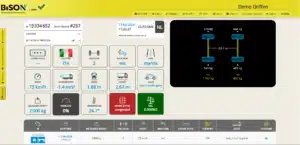
- real-time remote control and intuitive interface: an intuitive web dashboard enables live visualization of vehicular transits and structural response of the work.
GRIFFON thus supports the transition from reactive maintenance to predictive maintenance based on real data.
The technological core: fiber-optic sensor technology
The fiber optic technology employed by GRIFFON is designed to ensure reliability, durability and accuracy over time, even under extreme environmental conditions. The sensors used are completely passive, immune to electromagnetic interference and do not require local power supply, drastically reducing maintenance costs.
In the context of dynamic weighing, optical fiber enables extremely accurate detection of vehicular mass, even at high speeds, with a higher level of accuracy and stability over time than conventional sensors. The absence of active electronic components in the passage areas ensures reliability even in environments subject to vibration, rain, freezing or high temperatures.
With regard to structural monitoring, fiber-optic sensors allow a continuous distribution along the structure (distributed monitoring), offering a complete mapping of the structure’s behavior and facilitating the detection of localized anomalies. It is possible to configure the sensor network according to the criticalities detected or design requirements, adapting the distribution of sensors to the needs of the work.
Due to the inherent robustness of the technology, GRIFFON is designed for an extended operating life (more than 20 years) with low maintenance requirements. This is particularly relevant for applications in critical environments such as tunnels, viaducts or port areas with high traffic intensity. In addition, the system can be expanded over time, adding new functionality without the need to replace the basic infrastructure.

Software platform and integrated data management
All data collected from the sensors are acquired in real time by a purpose-developed software platform that resides locally at the acquisition unit. The system interface is web-accessible, with customizable dashboards and analysis tools that make it easy and intuitive to:
- Visualize vehicular transits in real time and correlate them with structural response;
- Monitor the health status of the structure through the response of monitoring sensors;
- Compare the trend of structural parameters over time, identifying anomalous patterns and drifts;
- Generate automatic statistical reports and configure critical alarm thresholds.
The GRIFFON system can also exchange data with the main information systems already in use by managing bodies and contracting stations according to standard protocols, and can be integrated into BIM and Digital Twin environments, support infrastructure digitization processes. The ability to export data according to interoperable standards is also provided, facilitating interaction with modeling and lifecycle management software.

Toward predictive and sustainable maintenance
GRIFFON fits into an evolved infrastructure management paradigm, where the continuous and integrated collection of data enables the anticipation of problems and the planning of targeted and timely interventions. This approach allows not only to increase safety, but also to optimize economic resources and reduce the environmental impact of maintenance activities.
The use of fiber-optic sensing and data integration make it possible to overcome the model based on periodic checks in favor of permanent surveillance, in which any significant changes are intercepted in a timely manner. This results in greater resilience of the infrastructure and increased confidence on the part of users and relevant authorities.
In a context where digitization of infrastructure is a strategic priority, GRIFFON was designed to combine innovative technological solutions with sustainability and management efficiency goals.
The case study of Brescia
The iWIM GRIFFON system has already been successfully implemented in an initial case study in collaboration with DICATAM (Department of Civil Engineering, Architecture, Land, Environment and Mathematics) of theUniversity of Brescia.
The bridge that is the subject of the pilot study, located in the southeastern area of the municipality of Brescia, is located along an important artery characterized by a very high average daily traffic (TGM) and a substantial transit of commercial vehicles, an important portion of which is in exceptional condition due to mass. After an initial monitoring, initiated in 2018 and coordinated by UNIBS with funding from the Province of Brescia, the bridge was subsequently applied for and funded-thanks to Next Generation EU and MUR funds-in the project promoted by MOST (National Center for Sustainable Mobility). Specifically, within Spoke 7, the project focuses on research in the area of cooperative connected and automated mobility and smart infrastructure, involving a broad partnership composed of universities (including UNIBS), research institutions, infrastructure managers and other actors.


The bridge allows provincial road SPBS11 (Southern Bypass), to cross a municipal road (Bettole Street). The two roads intersect at an angle of about 46°. The axis of the girders is parallel to the direction of the Southern Bypass, while the abutments are parallel to the underlying Bettole Street.
No design documents from the time of construction could be found. Therefore, the date of construction could not be traced with certainty nor design details obtained. It is assumed that the bridge dates back to the 1970s, a period of road development.

The deck consists of 13 precast reinforced concrete beams with a span of 24.60 m simply supported on the side abutments by elastomeric supports. There are also three cast-in-place reinforced concrete transverse dividers, one at mid-span and two at the ends. The overlying slab is made of reinforced concrete cast on prefabricated tiles (except for the overhangs), with a total thickness of 18 cm.


The bridge deck accommodates a total of four road lanes (two in each direction) with associated platforms, divided into two roadways separated by a central New Jersey-type barrier.
The bridge was chosen as a case study because it belongs to a type that is widespread in the Province of Brescia. Of the approximately 440 bridges inspected by the University of Brescia in the province, 44% are truss structures in reinforced concrete or prestressed concrete. In addition, the Southern Ring Road was selected because it represents a section of the primary road network of the Province and is one of the arteries with the highest traffic volume, among which the percentage of heavy vehicles is very impactful, due to the widespread presence of industries in the area (especially steel industries and quarries). Consider that on a typical day in February 2025, the two weighbridges detected a total of about 35,800 vehicles, plus the transits on the other two lanes (fast travel), with a percentage of commercial vehicles over 44 tons amounting to 2.3% (or 838 transits).
In-situ inspections revealed several degradation phenomena, mainly attributable, in addition to the age of the structure, to inadequate design of stormwater drainage and lack of maintenance work. The most degraded elements are the abutments and curbs (slab overhangs), in which moisture stains, traces of drainage, detachment of concrete cover with exposed and corroded reinforcement can be detected. As for the beams, the reduced thickness of the concrete cover has resulted in the exposure of the lower arms of the stirrups at the soffit of the beams.
Through a diagnostic campaign, the mechanical properties of the materials were determined, as well as the arrangement of reinforcement within the beams. A dynamic characterization of the artifact was also carried out through the temporary installation of accelerometers. Environmental excitation was used for this purpose. From the processing of the results (OMA method), a main resonant peak was identified at a frequency of 4.88 Hz.
Implementation details of the case study
As part of the case study, the bridge was instrumented through the installation of the GRIFFON iWIM system, which includes an advanced Weigh-In-Motion (WIM) system integrated with sensors that can directly measure the deflection, deformations and rotations of the bridge. All structural monitoring instruments used are Optical Fiber Sensors ( OFS).
The type and location of the sensors were specifically designed to determine the structural response of the entire work. Specifically, the following were installed:
- 3 biaxial inclinometers, near the span divider;
- 8 uniaxial inclinometers to accurately determine the deformations of the beams most affected by heavy vehicle transit (beam 2 and beam 12, in addition to beam 6 for comparison);
- 3 strain gauges capable of detecting flexural strain of beams, plus 1 strain gauge to measure any injuries related to shear phenomena;
- 1 laser technology-based sag sensor at beam centerline 2.
Two dynamic weighbridges (WIMs) are located near the bridge, both positioned on the slow lanes: one in the direction of Milan and one in the direction of Verona. The weighbridges allow the weight and axle spacing of a passing vehicle to be measured, as well as its travel speed and any acceleration or deceleration. This innovative structural monitoring system made it possible to integrate and synchronize the instrumental readings, i.e., the bridge response, with the passage of known vehicles thanks to measurements from the WIM.

Preliminary results
The work was modeled with Midas Civil software, so as to generate a refined and reliable finite element model(digital twin), which can dialogue with experimental measurements. The beams and stringers were represented with beam-type elements, while the slab was modeled with plate-type elements. Finally, a rigid connection was made between beam and plate, so as to obtain a collaborating section. The geometry and material characteristics are consistent with the information found from inspections and the diagnostic campaign. The frequency of the mode with higher participated mass in the Z direction (gravity force) is quite similar to that derived from the dynamic characterization, confirming the correctness of the finite element model.

As an example, the transit of a Milan-bound vehicle with a bridge fully in service was analyzed. The characteristics of the transport were measured using the WIM system. This transport was specifically selected for its high weight (amounting to 101.4 t), in addition since it crossed the bridge in the early morning hours, thus reducing the probability of concurrence of other vehicles on the fast lanes. In the finite element model, the vehicle was simulated using the “moving load” command.

For brevity, only the data obtained from the laser instrument (ref. H-T02) are compared: the maximum value recorded is 13.64 mm. In contrast, the deformation obtained from the finite element program is 13.28 mm (a value only 2.8% less than the experimental).

Preliminary analyses conducted showed excellent correlation between experimental data, obtained from the monitoring system, and the finite element model.
Conclusions
The GRIFFON system represents an integrated proposal for infrastructure monitoring, with particular reference to the combination of dynamic weighing and structural monitoring using fiber-optic technology. The integration between the two domains enables synchronous and continuous data collection, which is useful for understanding the relationship between vehicular loads and the structural response of the monitored structure. The ability to correlate traffic actions with the physical response of infrastructure works makes it possible to transform maintenance from a reactive exercise to a predictive process, with direct benefits in terms of safety, economic efficiency and environmental sustainability.
The presented case study highlights the possibility of modeling the structural behavior of the structure through the integration of experimental data with numerical simulations. The preliminary results obtained showed good consistency between the data acquired in the field and the model predictions, confirming the effectiveness of the integrated approach. The collaboration between the research community and the company has made it possible to develop and test a solution that can also be extended to other infrastructure contexts, with broad benefits in terms of maintenance management and planning.
AUTHORS
Guido Farinacci, Luca Trainotti, Paolo Armani – iWIM s.r.l., Trento, Italy
Nico Di Stefano, Enrico Faccin, Stefano Giuseppe Mantelli, Ivan Beltracchi, Elisa Carleschi, Emanuele Gandelli, Luca Facconi, Adriano Reggia, Giovanni Plizzari, Fausto Minelli – DICATAM – Department of Civil Engineering, Architecture, Land, Environment and Mathematics – University of Brescia;
Pierpaola Archini, Stefano Vitalini and Luisa Zavanella – Roads and Transportation Sector at Province of Brescia;
NOTES: This work is part of the research activity developed by the authors within the framework of the “National Recovery and Resilience Plan (NRP): SPOKE 7 “Cooperative, Connected and Automated Mobility (CCAM), Connected Networks and Smart Infrastructure” – WorkPackage 4 (WP4), CUP: D83C22000690001.
Published by: Roads & Highways, EDITORIAL HOUSE EDI-CEM SRL 5.2025 – read article